
In June 2019, a civic list comprised mainly of young people without prior political experience wins the elections after 25 years of municipal administrations by the same political party. Despite not believing they could defeat the status quo, the list emerges victorious and begin a new administration.
We are in a quaint Italian coastal town with a population of approximately 3,000 residents. The town primarily thrives on seasonal tourism. Despite the enthusiasm and strong drive for change generated by the election, the team faces challenges due to their lack of experience, encountering bureaucratic obstacles, and opposition from those entrenched in politics. As a result, the team is beginning to feel weary and discouraged. Even their relationship with their supporters, who had fervently backed them during the campaign, is starting to show signs of strain.
After a year in office, as the world is facing the Covid-19 pandemic that is wiping out meetings with citizens and preventing in-person meetings, some members of a team, including the deputy mayor, have acknowledged the need for assistance to ensure that their long-awaited opportunity does not turn into a failure, after a year in office.
In this context, in July 2020, we get in touch with the team at the invitation of the newly appointed deputy mayor.
The initial analisys
The first meeting is fundamental to getting to know each other, explaining who we are and what a Team Coaching intervention can be useful for. In this case, the meeting with the team and the mayor takes place in person and is an opportunity to listen to their expectations with particular attention to the reflections of those who do not feel very involved, such as the town planning councillor, who shares that he feels it is more urgent to devote himself to the development of technical skills.
A subsequent meeting only with the mayor allows us to begin building a relationship with her as, in her role as team leader, she is a key player in the project's success. In agreement with her, we carry out an initial internal analysis by means of a questionnaire, individual interviews and an online group meeting. In line with the systemic approach we propose, we facilitate from the outset the creation of a map of external stakeholders in order to listen to their voices.
The first group meeting is also an opportunity to gather their expectations on the objectives of the course.
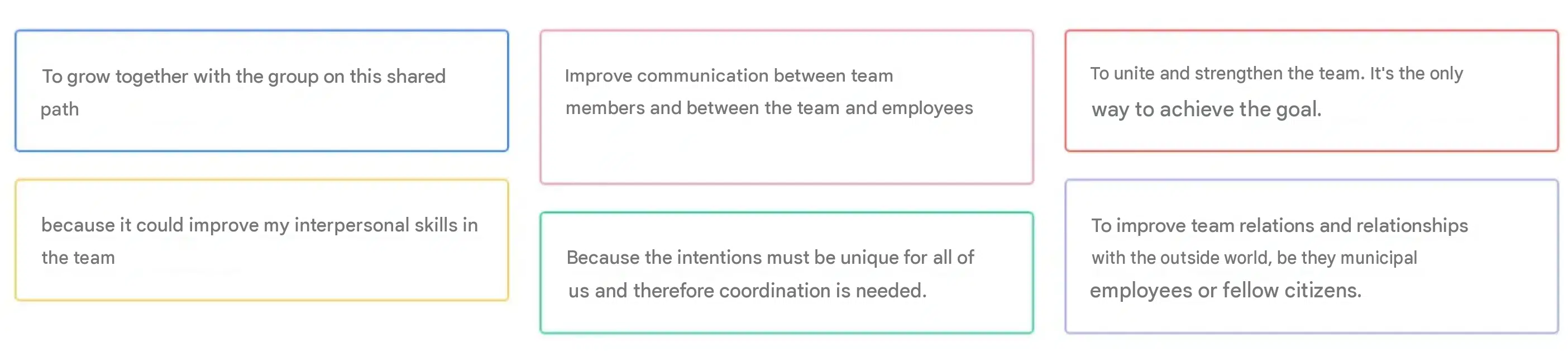
Certain needs become apparent.
Improving the efficiency of their mandate. Taking over the inherited situation and learning to move as a team in an unfamiliar space is taking longer than expected, and the results promised by the council are still far from materialising.
Improving communication to reconnect with voters. Even the voters closest to the council have little opportunity to know what is happening and are beginning to lose faith in the new council.
Improving communication with the offices. Sometimes, the employees hired by the previous council in the official offices appear not always willing to cooperate.
Improving communication within the team. There are various issues that arise with internal communication, such as the disorganized use of chat applications (like WhatsApp), which can create an overwhelming amount of unhelpful messages, or the lack of psychological safety and trust among team members, that makes it difficult to provide constructive feedback without fear of it being taken personally. They share with us that this happens in particular because they have joined this adventure from friendship relationships, even dated ones, which can sometimes create an obstacle to sincere feedback.
Being more time-efficient. In order to accommodate everyone’s work schedule, meetings are typically held in the evening, which often results in fatigue and prolonged duration with little tangible outcomes. Furthermore, this schedule can disrupt personal life, encroaching on family time.
This last thing, in particular, appears to be a cross-cutting issue that impacts all others. Given the size of the municipality, in fact, the mayor is the only one who has a full-time paid position. In contrast, the rest of the team has to manage their position in addition to their work, often finding themselves working in the evening hours.
This first exploration shows us how they see themselves and their work.
With this in mind, we challenge them to broaden their vision to find out how they are viewed by the outside world, especially by all those people, entities and organisations that are stakeholders in the team’s work.
The next step is then a survey to measure how much they are overseeing the five fundamental disciplines for a high-performance team, theorised by Peter Hawkins in his model (Fig. II).
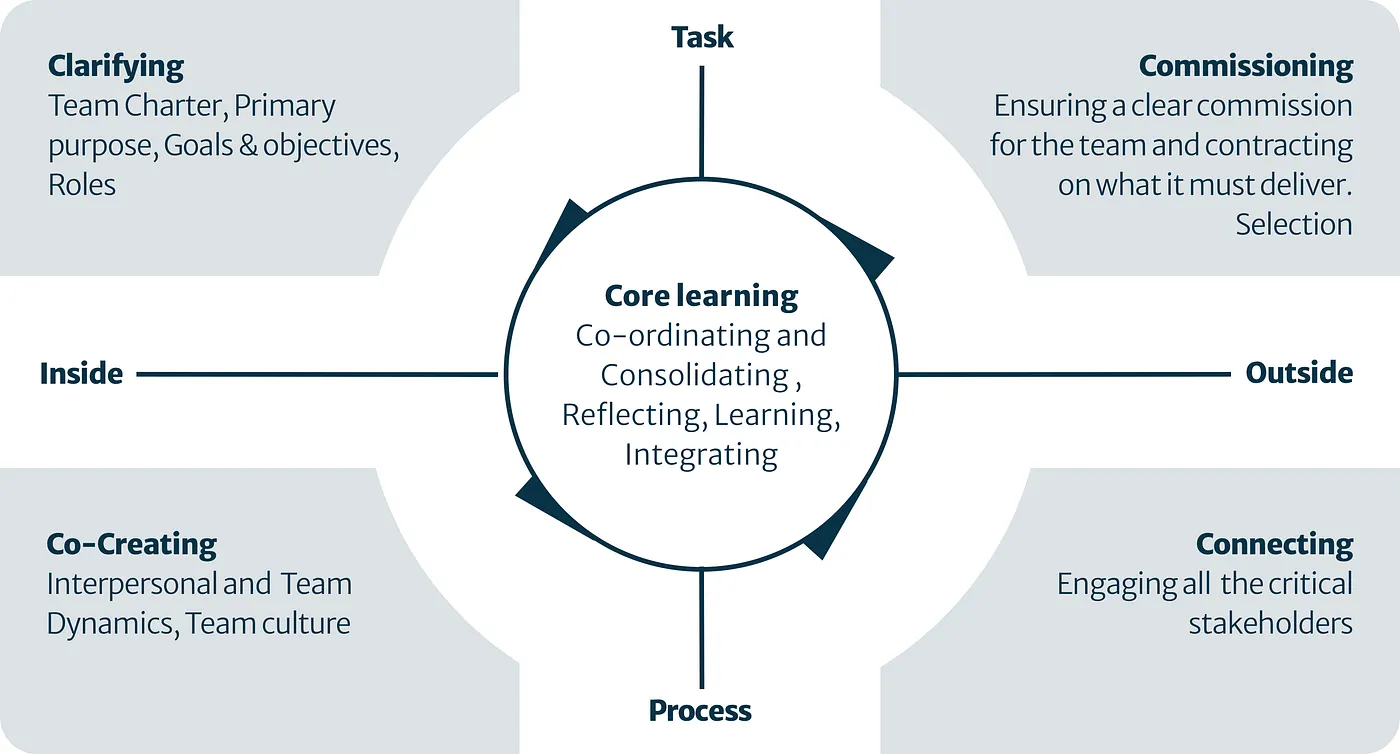
The survey involves a set of questions presented to the team, another set sent to the stakeholders who are deemed significant, and interviews conducted with them afterwards to delve deeper into the themes that surfaced from their responses. During the interviews, a team member who shares a strong relationship with the stakeholder joins us. These interviews serve the purpose of gathering valuable information and re-establishing a connection with the external world. This helps in building a trustworthy relationship and validating the mandate.
At the end of this analysis, we obtain a 360-degree snapshot that is essential for the next steps.
In two sessions, between December and January, together with them, we explore the results of the analysis and define the priorities of the team coaching process.

Seeing the Team
The internal survey questionnaire is an opportunity to inquire about vision and priorities now that they have a mandate. The data returns a somewhat surprising picture: there is a lack of true alignment on vision and priorities (Fig. III).
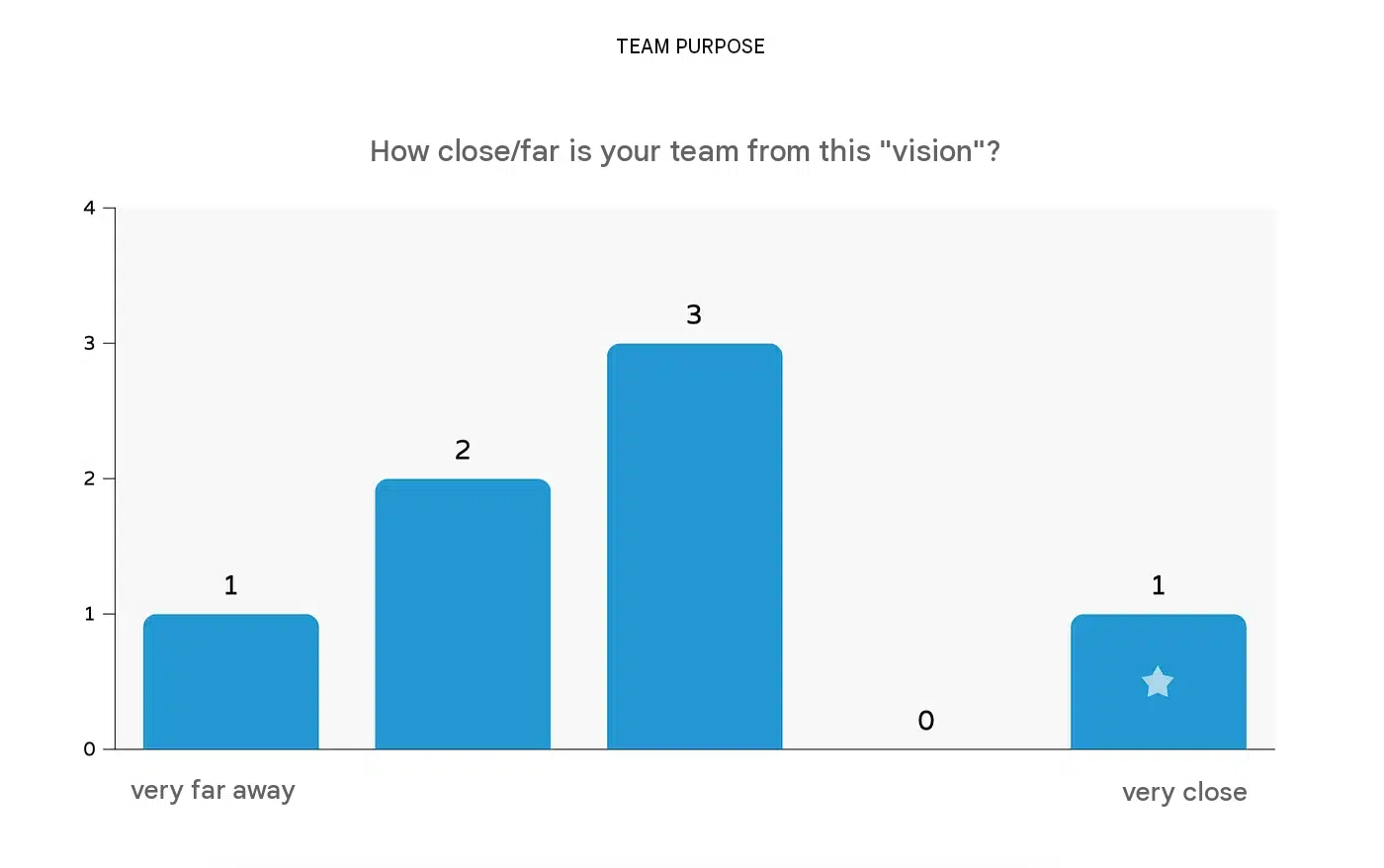
The questionnaire results allow for discussion on delegation, decision-making, internal communication and the ability to communicate effectively with stakeholders.
By showing members a broader view than the individual, the session prepares the field for the next session: the one where we look at the results of the external survey, where the system around them gives feedback.
Seeing The System
To see the System, we focus on the results collected from the stakeholders with the questionnaire and interviews; this allows them to see for the first time clearly what the situation is beyond the personal perception of individuals.
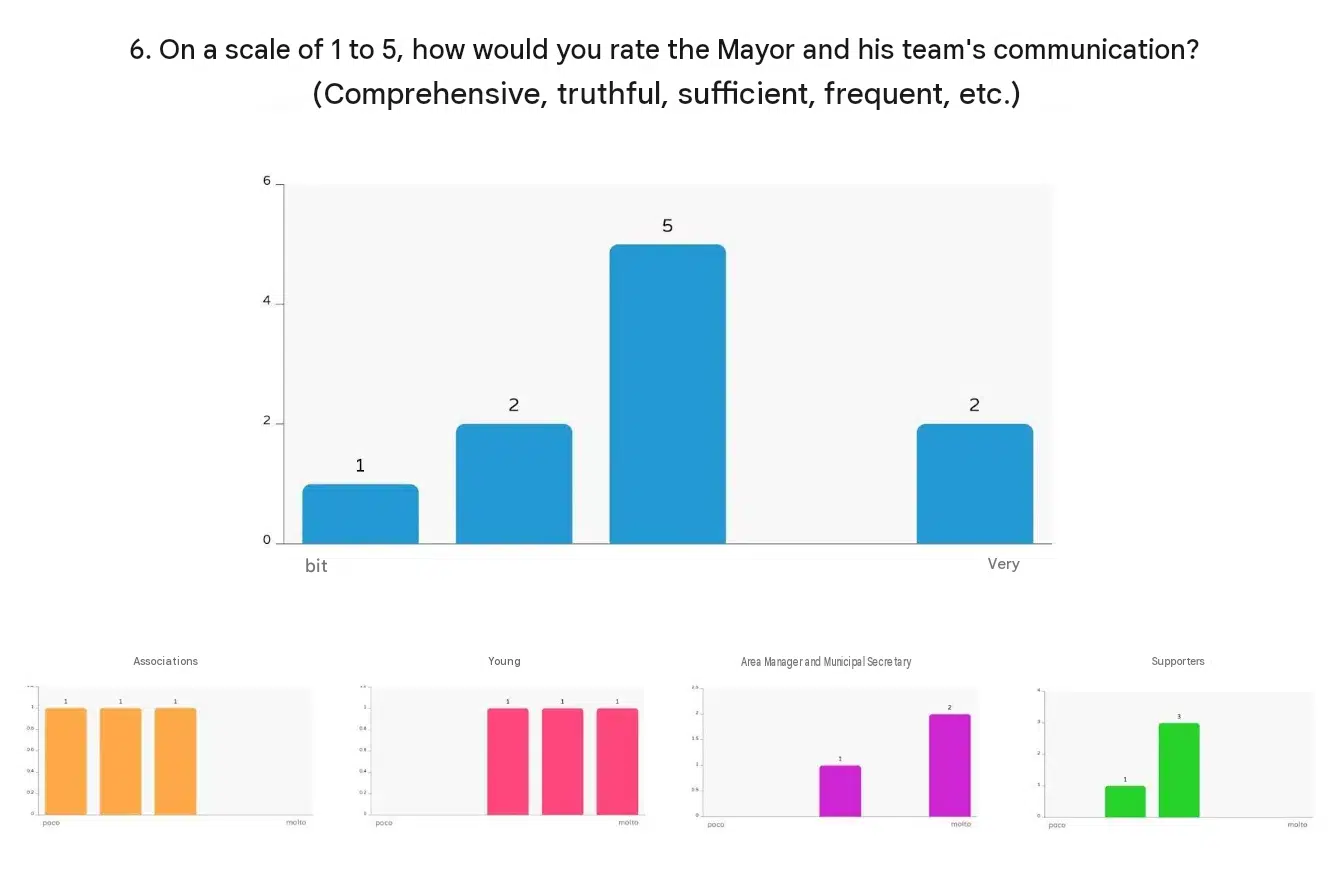
The emerging themes partly confirm what was identified through the internal survey but also clearly show the strengths of the team that were not fully visible before:
“Young, honest and hard-working group”
“Group without a history in politics”
“Determination and transparency, active dialogue with citizenship”
An analysis of individual stakeholder groups (Fig. IV) also allows us to see which groups are most critical.
There also seems to be a need for the following:
more assertiveness towards employees;
better direct communication (no social) with citizens, office managers and officials;
improved communication between councillors.
As coaches, we add our personal observation lens to the external one. Our observations reflect what was discovered in the survey. Evidently, the team is relatively young, with diverse work backgrounds, and lacks the necessary experience and tools to work cohesively. This information will be critical in guiding the team towards the project's next phases.
Co-designing the journey
Based on the data obtained from the internal and external inquiry, we invite them to define priority topics for the team coaching journey (what to focus on) and then map them on the five disciplines diagram (Fig. V).
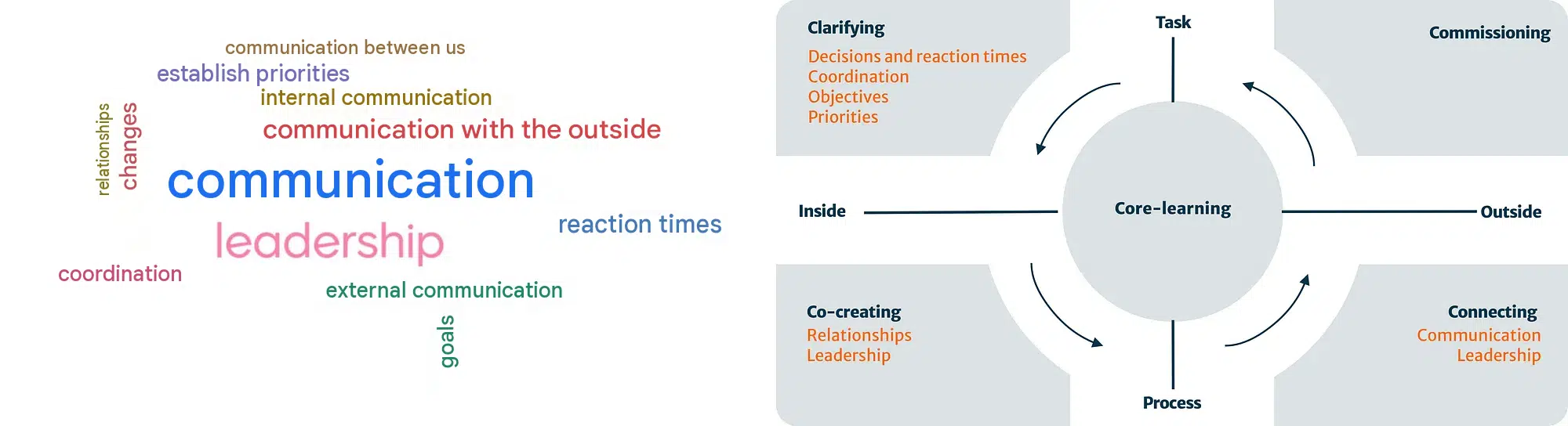
The observation of the objectives within this scheme finally allows everyone to have a systemic view and observe the interdependence of the objectives and the actions needed to achieve them.
Thanks to this in-depth investigation phase, they are finally in a good place to co-design and take ownership of the team coaching journey.

They decide to start from the exploration of the Clarifying discipline in order to be able to clearly define and share objectives, priorities, and roles and on those to build team relationships (Co-creating) and the leadership needed to carry out the work and communication with the outside world (Connecting).
Clarifying
To begin exploring the Clarifying discipline, we suggest creating a Team Charter. This comprehensive document includes key elements such as mandate, purpose, strategic orientation, values, vision, goals, roles and responsibilities, working agreements, and key performance indicators.
In agreement with them, we focus the exploration on defining roles, responsibilities and working agreements, leaving the completion of the Team Charter to them.
After months of working asynchronously, often managed with communication via WhatsApp, they become aware of the importance of being together, albeit in a virtual environment, all at the same time.
Therefore, they book a weekly meeting on the agenda right after dinner to allow everyone to be present without being absent from the main work.
The meeting space holds significant importance in determining whether the stated values are truly being implemented in the teamwork. In one such meeting, we suggest an observation and coaching exercise to offer an external perspective on how the shared values are being applied in their daily work. The observation session reveals ways to enhance meeting efficiency and productivity, encouraging the team to collaborate and create value together.
Co-creating
When we start working on this discipline, a so-called black swan arrives: a councillor, without warning, resigns.
It is a moment of shock for them as they try to rationalise what has happened (“What could we have done differently?”) or to foresee the impact (“What will the citizens’ reactions be? Who will take his place?”).
It is also an ideal opportunity to look at the role of interpersonal dynamics and internal communication within the team.
We decide an in-person meeting is necessary to recreate an environment of trust that can lay a new foundation of value.
They accept the invitation.
The session focuses on activities that allow, on the one hand, to see the internal relational dynamics through a team game and, on the other hand, to create a space of trust and psychological safety in which the unspoken can emerge. Someone reacts by saying, ‘We always tell each other everything!’ a statement that very often indicates a fragile situation in which, to maintain a friendly environment, the dissent does not have the space to be shared.
The activity brings to light some sensitive issues that can finally be looked at and managed as a team.
One of the members is not present at the meeting, and we invite the others to consider him, for this session, as a stakeholder.
We do a role-playing exercise by asking one of the members to sit in the empty chair representing the absent member and “play his role” while the others can interact to discuss what the team is doing and discovering in the session. It is a job that brings them into the shoes of another member for the first time with this depth.
The mayor, as the team talks about the difficulties in dealing with the internal offices of the municipality, admits that she does not feel able to do this and is open to exploring an alternative solution.
At the end of this in-person day, the person who was initially most sceptical about our role and the process shares her enthusiasm for the session that has just ended, admitting that she has changed her mind from her initial misgivings and thanking us for our work.
Some important learnings emerge from these meetings:
the importance of coming together, particularly in physical presence. The team game we proposed made them reflect on the importance of arriving at “solutions” by sharing the challenge: together, they are more than the sum of the parts;
sharing experience highlighted the difficulty of saying things transparently to each other without adequate psychological safety space;
bringing the voice of the absent person into the session and addressing them honestly strengthens the relationship and turns adversity into opportunity.
Everyone recognises that the energy was higher in this session than in previous sessions, and we aim to reconnect with this energy and continue to nurture it in future sessions, however virtual.
In the following weeks, one member of the team assumes responsibility for the role of project manager for everyone, a skill that is her own. Then emerges a planning exercise for their activities, which they find effective, in which they write down in black and white the timetables and who is responsible for each area.
Towards the end of the journey

A combination of circumstances, including the resignation of the councillor and insufficient time and energy from the team to carry on the work between sessions, did not allow us to explore the Connecting discipline with them in the timeframe agreed upon for the intervention.
Wanting to make the most of the limited time available, they concluded the course with individual interviews instead of a plenary session.
From these interviews, it emerges that thanks to the team coaching journey, they have achieved several significant goals:
They discovered how to make better use of internal resources and improved decision-making processes;
They understood what to do as a team and what to delegate, investing in shared leadership;
They created the psychological safety that allows healthy debates and co-creation;
They improved internal communication;
They improved communication with offices and the citizenship;
They discovered they had internal resources they were unaware of (a project manager).
Conclusions
The context in which this team operates is particularly challenging. Many of the challenges and complexities that belong to the work of any team are amplified in a context such as that of a city council, deeply immersed in the social system of which it is a part. The systemic approach of Team Coaching that we used proved essential to support their growth in such a context.
The work done and the results achieved in such a short time frame and in such a complex context are further proof of the effectiveness of the systemic approach to Team Coaching.
There is no development of the individual and the team without taking into account the mandate it receives from the outside and the vision of how the team wants to see itself in the future for the benefit and achievement of the results of the organisation or community of which it is a part.
A team is a fundamental unit within any organisation. As Team Coaches, we can therefore make a concrete contribution to organisations by helping teams improve their performance and increase the value of the entire system in which they are embedded.